Maintenance
Part of Ceramics projects sized for one kiln shelf, chosen to build skill fast
4 points on small ceramics projects that matter
Four habits ruin more home ceramics than any skill gap: dry sweeping, rushed drying, glaze that does not fit, and small batches treated as small exposure.
Four habits account for most ruined pots in a home studio, and for all the avoidable dust risk. None of them is a skill problem. Each is a routine you can change this week.
What to take away
- Dry sweeping puts settled silica back in the air. Wet sweeping or a HEPA vacuum does not.
- A standard shop vacuum passes the finest dust straight through its exhaust.
- Rushing the dry costs more pots than any forming error. Cracks show at handles, rims and bases.
- Glaze fit is structural. Crazing and shivering come from the materials, not the application.
- Small batches do not shrink the exposure. Measured classroom air says otherwise.
Mistake one: cleaning dry
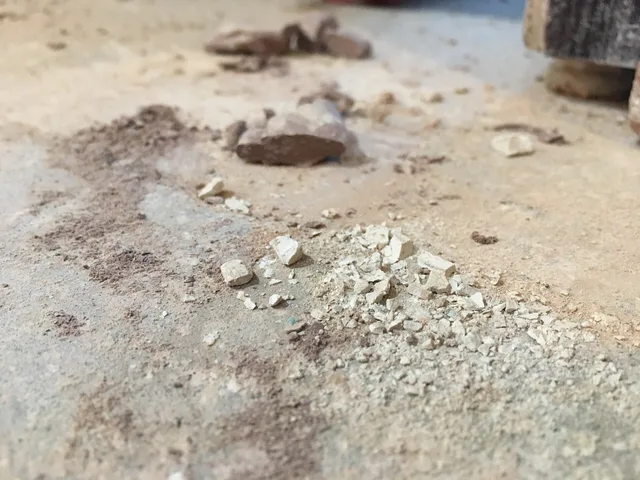
Sweeping a ceramics room lifts settled dust back into the air, where it hangs long after you stop. OSHA's general industry rule for respirable crystalline silica sets a permissible exposure limit of 50 micrograms per cubic meter over an eight-hour average, with an action level at 25.
Silica exposure limits
- 50 µg/m³Permissible exposure limit, 8-hour average
- 25 µg/m³Action level
- BannedDry sweeping and compressed air
That rule bars dry sweeping and compressed air where wet methods or HEPA vacuuming are feasible.
A home studio is not an employer, so the duty does not bind you. The finding still applies: the people who measured this concluded dry sweeping was not acceptable at those concentrations. Wet sweep, mop, or use a vacuum rated for fine dust.
Mistake two: assuming small scale means small exposure
Scale does not follow from batch size. A study of respirable crystalline silica in high school ceramics classrooms sampled 11 rooms in Salt Lake County. Classroom air averaged 0.009 milligrams per cubic meter, and the air near the kilns 0.006.
Against an occupational limit of 0.025, the authors calculated a 21 percent exceedance rate, about one work day in five. Concentration tracked with how many students were in the room.
A teaching room sits closer to a spare bedroom than to a factory. If ordinary class activity lands there, a garage with no ventilation and a broom will not do better.
Mistake three: hurrying the drying
| What went wrong | What you see | The fix |
|---|---|---|
| Dried too fast | Cracks at handles and rims | Cover loosely, dry slowly and evenly |
| Not bone dry at bisque | Piece breaks apart in the kiln | Wait longer; weigh it if unsure |
| Uneven wall thickness | Warping, S-crack in the base | Compress the base, even the walls |
| Cooled too fast | Hairline cracks after firing | Let the kiln cool on its own schedule |
That last row has a name. Glossaries call it dunting: cracking from cooling too quickly, showing as hairline cracks or a piece broken outright. It hits uneven cross sections, poor glaze fit and large flat pieces hardest.
Mistake four: treating glaze as decoration
Glaze fit is structural. A glaze that shrinks more than the body crazes. One that shrinks less shivers and sheds flakes. Applying it thinner or thicker will not fix either, because the mismatch lives in the materials.
Test a new glaze on your body before committing a batch, and hold the materials decision steady while you test. The practices published by studios exist because these four failures are that common.
Common questions
Is a HEPA vacuum really necessary at home?
If you vacuum at all, yes. A standard vacuum passes the finest particles through its exhaust, and that is the fraction that reaches deep into the lung. A wet mop and a bucket cost less and work as well on floors.
How do I tell if a piece is bone dry?
It sits at room temperature rather than feeling cool, and its weight stops falling between days. If you are unsure, wait another day. Greenware cracking through a British Columbia winter is usually this, not the clay.
Can I fix crazing by refiring?
Rarely. Crazing is a mismatch between glaze and body expansion, and heat does not change that. The durable fixes are changing the glaze or changing the clay body.
Does a fan help work dry evenly?
No. A fan dries exposed surfaces faster than the rest, which is the condition that cracks pots. Slow and covered beats fast and uneven.