Maintenance
Part of Best pottery tools for 2027: a ranked shortlist
Good pottery habits compared with the small mistakes that waste gear at home
Buying tools instead of hours, letting them dry dirty, mixing up bodies through shared tools, and skipping the equipment that studios treat as basic.
Home studios rarely fail on the big things. They fail on small habits. The good pottery habits that prevent those failures cost less than the gear they save: throwing the hours, washing tools while the clay is wet, keeping one clay body, and knowing which equipment studios treat as basic.
What to take away
- Buying tools is not practicing. Hours at the wheel are what improve the work.
- Wash tools while the clay is wet, every session, without exception.
- Shared tools carry clay between bodies. One body avoids the problem entirely.
- Some equipment cannot be improvised. Knowing which is the useful judgment.
- Glaze chemistry and kiln building are courses, not purchases. Dry powders need a NIOSH-approved respirator first.
Habit one: throw the hours instead of buying the tool
The temptation is obvious when equipment is easy to buy and studio hours are not. It is worth seeing what a serious program gives someone.
One ceramics department lists sixteen electric wheels, three motorized kick wheels and a treadle wheel. The same department runs ten semi-private undergraduate studios, two clay mixers, three de-airing pug mills, and a slip casting laboratory with a vacuum chamber.
It also has a dedicated glaze lab with a ball mill and blunger. The department runs four gas kilns from 6 to 82 cubic feet, five electric kilns, a crystalline glaze kiln and a raku kiln.
A separate 6,000 square foot kiln shed holds a 450 cubic foot anagama and a 130 cubic foot noborigama.
Nobody competes with that at home, and nobody is trying to. What the program sells is four years of supervised hours: a 120 credit hour degree in which students learn to handbuild, throw, slip cast and make molds. Hours, not machines.
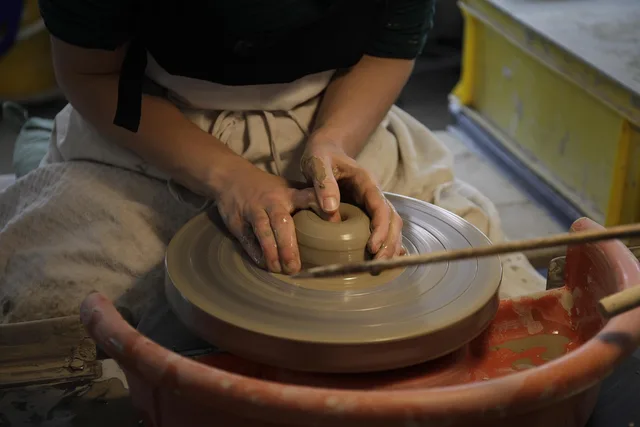
The home version of that habit is simpler. A Brent wheel from Amaco or a Shimpo RK-55 Whisper costs roughly $1,400 to $2,000 new, and either one centers clay every day for years. Neither throws a pot.
Used Brent C and Shimpo wheels turn up on local listings for about half of new, typically $700 to $1,200.
Habit two: wash tools while the clay is wet
Dried clay on a rib changes the mark it makes. Dried clay in a sponge stops it absorbing. Dried clay on a needle tool rusts it. Every one of those deposits becomes dust the next time it is knocked loose.
- Wash tools in the bucket, not under a running faucet.
- Dry metal tools before storing them.
- Replace sponges when they go hard rather than working around them.
- Keep tools in a tray, not in the splash pan.
The gear that punishes neglect is specific. Ribs from Kemper and Sherrill Mudtools trap clay along their edges, and a sponge that has gone hard skips across a rim instead of absorbing water. A fresh elephant ear sponge costs a few dollars.
Habit three: run one clay body and label the tools
A rib used on a dark iron body carries iron into the next white pot. A trimming tool moves grog between bodies. A reclaim bucket contaminated once stays contaminated, because two clays cannot be separated once they are slurry.
Running a single clay body removes the whole class of problem. That is why studios standardize on one, and why almost every open studio refuses clay brought in from outside.
Laguna B-Mix, a cone 5 white stoneware sold in 25 pound bags, and Amaco Potter's Choice glazes, mixed for cone 5 and 6, let a home studio run one body and one glaze range. If you keep two bodies, mark one set of ribs and sponges for each.
Habit four: know what cannot be improvised
Some things do need equipment. A graduate ceramics program describes its curriculum as including clay and glaze formulation and kiln construction.
The course of study runs two to three years and 60 credits, with assigned workspace and access to labs, equipment and tools, and ends in a visual and written thesis.
Formulating glaze from raw materials and building kilns are where improvising at home goes wrong fastest, because both involve materials and heat rather than technique. Everything else on the list can be done more slowly by hand. Keep that boundary in mind when choosing materials and when judging tools you are tempted to buy.
A pug mill is the clearest example. Bluebird's 440 and Peter Pugger's VPM-9 both cost several thousand dollars new, typically $3,000 and up, and both do a job a bucket and a wire can do slowly.
A kiln is the other exception. Skutt's 1027, a 7 cubic foot electric model with a KilnMaster controller, typically sells for $3,000 to $4,000 new.
Common questions
How do I know if I am buying instead of practicing?
Count the tools you used last month, then count the ones you bought. If the second number is larger, the answer is clear.
Can I use one set of tools for two clay bodies?
Only with thorough washing between, and even then reclaim will mix. Running one body is simpler and cheaper.
Do metal tools really rust that fast?
Carbon steel does, in a studio that is wet daily. Dry them, or buy stainless, or accept replacing them.
Is it worth learning glaze chemistry at home?
Eventually, and carefully. It means handling dry powders, so it needs ventilation and a NIOSH-approved respirator before it needs a recipe book.