Features
Part of Ceramics projects sized for one kiln shelf, chosen to build skill fast
Can you design a small ceramics project around a single skill?
How to design a ceramics project around a single skill, using the sequence college handbuilding courses follow, so each piece answers one question.
Most beginner projects fail as teaching because they try to teach everything at once. A lidded jar with a handle, a carved surface and a new glaze has four variables, so when it goes wrong nothing is learned. The fix is to design each project around one skill and hold everything else constant.
What to take away
- One new variable per project. Everything else stays as it was last time.
- Learn the handbuilding methods in the order courses teach them: pinch, coil, slab.
- Write the question down before you start, and the answer when you finish.
- A project that goes wrong tells you nothing unless you kept the other variables fixed.
The order the courses use
College handbuilding courses follow a consistent, non-arbitrary sequence: a published course outline for beginning handbuilding lists competency in coil, slab, wafer and pinch methods. It then covers glazing through pouring, spraying, dipping and brushing.
Handbuilding difficulty ladder
- Pinchhands on wall thickness
- Coilbuilding separate from thinning
- Slabpunishes uneven drying most
- Then glazingpouring, spraying, dipping, brushing
- Also resist and sgraffito
- Solve slumping and cracking
It also covers resist and sgraffito, and names the construction problems students must solve: slumping and cracking.
Pinch first because it puts your hands directly on wall thickness. Coil second because it separates building from thinning. Slab last because slabs punish uneven drying more than any other method. That ordering is a difficulty ladder disguised as a syllabus.
Design a single-skill project
- Name the skill in one sentence. Even wall thickness. A clean join. A foot that sits flat.
- Choose the simplest form that requires it, and make it six times.
- Hold the clay body, the glaze and the drying method constant.
- Record what changed between the first and the sixth.
- Cut one open. Looking at a cross section beats guessing.
The sixth piece is the point of the exercise. The first is just the cost of starting.
Single-skill project setup
- Name the skill in one sentence
- Choose simplest form that requires it
- Make the form six times
- Hold clay body constant
- Hold glaze constant
- Hold drying method constant
- Record changes from first to sixth
- Cut one open to inspect
Matching skill to project
| Skill | Project | How you know it worked |
|---|---|---|
| Even walls | Pinch bowls, six of them | Cross section shows constant thickness |
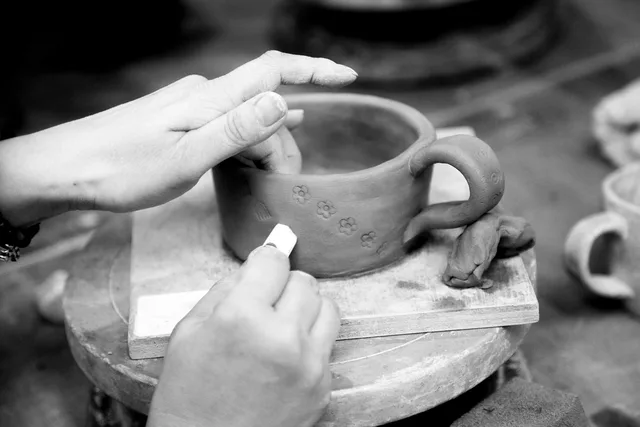
| Clean joins | Coil-built cup with a coil handle | No crack at the join after drying |
| Flat forms | Four square tiles | They come out of the kiln flat |
| Compression | Wide shallow dish | No S-crack in the base |
| Glaze thickness | One glaze, four dipping times | Four visibly different results |
Tools are part of the variable set
Settle your kit before you start; changing tools mid-project adds a variable, and a community college handbuilding resource list names the standard set: wire cutter, pin tool, score tool, banding wheel, brayer. Add rubber rib, fetting knife and slab roller.
Most single-skill projects need four of those. Swapping a metal rib for a rubber one halfway through a set of six changes the surface enough to confuse the result.
The same discipline applies to what the pieces are made of, which is why choosing one clay body and staying on it matters, and why picking projects that fit a single kiln shelf makes the repetition affordable.
Common questions
Is six repetitions really necessary?
Fewer than that and you are still learning the setup rather than the skill. Six is a working minimum, and for wheel forms it is closer to twelve.
Can I combine two skills once I am comfortable?
Yes, and that is the natural progression. Combine only after each one works alone, so that a failure still has an identifiable cause.
What if all six come out badly?
Then the variable you fixed was the wrong one. Cut two open, look at the walls and the joins, and pick the next single question from what you see.
Should I glaze practice pieces at all?
Glaze half of them. Unglazed pieces cost less and teach forming; glazed ones teach fit and thickness. Firing all six glazed doubles the cost for little extra information.