Reviews
Part of Ceramics projects sized for one kiln shelf, chosen to build skill fast
Checklist for outfitting a first ceramics project with six hand tools
The short tool list small ceramics actually needs, what each item does, and the studio machines you can ignore until the work outgrows your hands.
Small work needs a small kit, which is the useful thing about it. Nothing here was tested or purchased, so no brands are named, but the list of jobs a tool has to do is stable no matter who makes it.
What to take away
- Six hand tools cover almost every small ceramics project.
- Buy a banding wheel early. It is cheap and it changes how you work.
- Studio machines exist for volume, not for capability.
- Learn the vocabulary. Half of tool confusion is people using the same word for different things.
The six that matter
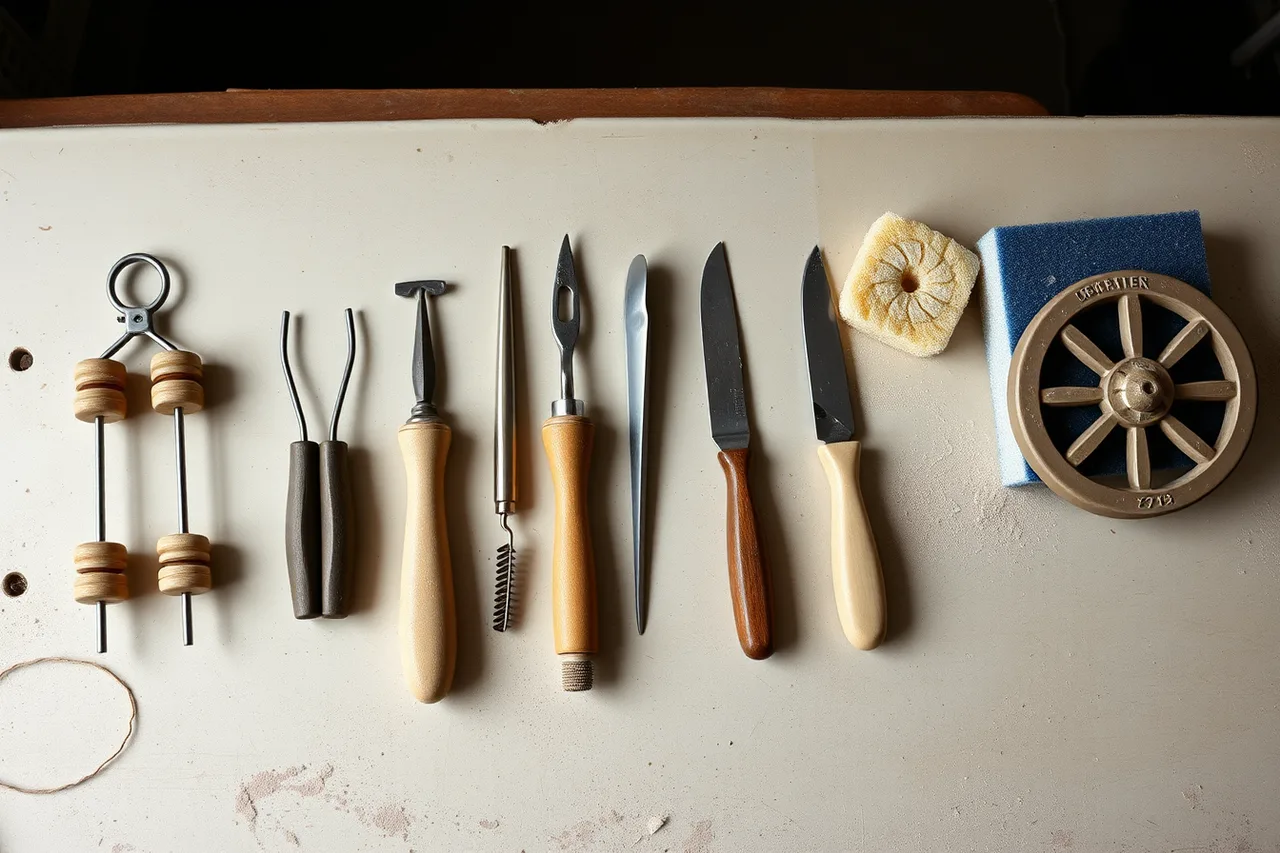
- Wire tool, for cutting clay from a block and releasing work from a bat.
- Pin or needle tool, for leveling a rim and checking wall thickness.
- Score tool, for roughening surfaces before joining.
- Rubber rib, for smoothing and compressing without cutting.
- Fettling knife, for trimming edges and cleaning seams.
- Banding wheel, so the piece turns instead of your body.
Those six plus a sponge and a brayer make the standard handbuilding kit that teaching studios list. Add a slab roller only when rolling by hand becomes the thing you dread.
The words are part of the toolkit
Tool talk confuses because one term means different things in different places. A university ceramics glossary of basic terms notes that in North America a bat is the wood, plastic or plaster disk you throw on, held by pins or an interlocking fitting or stuck down with slip.
In the United Kingdom, a bat is a kiln shelf, so bat wash there means kiln wash.
The same glossary defines bisque as the first firing, usually low, around cones 012 to 04. It is fired high enough to burn away carbonaceous matter yet low enough to leave the body absorbent so glaze goes on easily.
Getting those two straight prevents most beginner ordering mistakes.
What the machines are for
Job
- Slab roller
- Even slabs at repeatable thickness
- Extruder
- Repeatable coils, handles, tube sections
- Press or die
- Identical parts at volume
- Ball mill
- Grinding and blending raw glaze
- Pug mill
- Reclaim at volume
Small-work verdict
- Slab roller
- Skip; rolling pin and guides work
- Extruder
- Useful once forms repeat
- Press or die
- Production only
- Ball mill
- Only if mixing from raw materials
- Pug mill
- Skip until reclaim outpaces you
Institutional labs hold machines a home studio never will. A university ceramics lab inventory lists wheels, kilns, extruders, slip tables, a 30 ton ceramic press and a ceramic roll press alongside a 3D printer. Those exist because a department makes hundreds of identical parts. For small work made one at a time, none is a prerequisite.
Spend the money on firing instead
A tool budget spent on hand tools runs out quickly, and the remainder is better put toward firings. More firings means more feedback, and feedback is the real constraint on getting better. Pick projects that fit one shelf so a single firing carries a dozen results, and keep one variable moving at a time so those results mean something.
Common questions
Do I need different tools for hand building and the wheel?
Mostly no. The wheel adds a trimming loop and a sponge on a stick. Everything else on the list works for both.
What is a brayer for?
Rolling and compressing slabs, and pressing texture into them evenly. A hard rubber one costs very little and does a job your hands do badly.
Are wooden or metal ribs better?
They do different jobs. Metal cuts and compresses, wood shapes, rubber smooths. Own one of each rather than three of one.
Is a cheap banding wheel good enough?
For small work, usually yes. What matters is that it spins freely and does not wobble under a loaded piece. Test both before buying if you can.