Maintenance
4 details of home kiln setup mistakes people miss
Four home kiln setup mistakes that ruin pots include no vent, guessed clearance, firing damp greenware, and dry cleanup that lifts silica dust into your lungs.
Home kiln failures are dull and repetitive, which is good news, because that means they are all avoidable. Four cause most of the damage, and none of them is about skill at the wheel.
What to take away
- Skipping the vent is the most common and the least reversible mistake.
- Vent with a downdraft unit or a ducted canopy hood. An open window only dilutes the fume.
- Clearance is a measured number. Most manuals list 12 to 18 inches to a combustible wall and about 24 inches in front for loading.
- A kiln needs a dedicated 240 volt circuit, with the breaker at 125 percent of the nameplate amps.
- Damp work does not survive a bisque, and it takes its neighbors with it.
- Clean up wet. Dry dust is the exposure.
- Cones in every firing catch a drifting controller before it ruins a shelf of pots.
Mistake one: buying the kiln before checking the room
The kiln is the easy purchase. The circuit, the clearances and the duct are the hard part, and the building decides them. People buy first, then find the only wall that suits the duct is the one with the breaker panel on it.
Measure the room before buying
- Measure the room first
- Check circuit capacity
- Check kiln clearances
- Check duct route
- Avoid wall with breaker panel
- If it fails, change room or kiln
Measure first. If the room cannot take the clearances, the answer is a different room or a different kiln, not a smaller gap.
Clearance figures come from the kiln's listing and the manufacturer's manual, which lists them for the model you own. Most manuals give 12 to 18 inches to a combustible wall, a stated gap above, and about 24 inches in front for loading. Those are typical ranges; the manual for your model is the number that counts.
Building codes and fire codes can demand more clearance than the manual. Take the largest figure among the manual, the building code and the fire code.
The circuit is a separate decision. The NEC treats a kiln as a continuous load, so the breaker and the wire are sized at 125 percent of the nameplate amps.
A kiln rated at 24 amps sits on a 30 amp circuit, and a 48 amp kiln needs 60 amps. A licensed electrician sets the final size.
Vent sizing comes from the vent maker, not from guesswork. A downdraft vent, the type sold as the Skutt EnviroVent, pulls fume from the bottom of the kiln through a small duct, typically 2 to 3 inches.
A canopy hood captures rising fume and typically needs a 6 inch duct or larger. Keep the run short, the elbows few and the outlet outdoors.
A UL or ETL listing mark on the unit is the starting point, not the whole answer.
Landlord rules and fire codes vary by municipality, so confirm with the authority having jurisdiction before the crate is opened.
The floor, the room and the permit
The floor must carry the kiln's weight and anything near it. It must be non-combustible. Concrete is best; otherwise set the kiln on a non-combustible pad. Never put a kiln in a closet, a cabinet or a very small room.
Ask your local building department whether a permit is required. A permit may cover wiring and structural work. It does not cover your duty to vent the kiln or your decisions about firing.
Settle four things before you buy: the circuit, the floor, the air gaps and the fume path. Measure the room, check clearances against the model you want, have a licensed electrician confirm the circuit, and plan the duct run. Then buy the kiln, the vent and the shelves together.
Mistake two: treating cleanup as tidying
Cleanup is the primary exposure control in a ceramics space, so occupational guidance writes it down as a task with a method. The federal small entity guide for the respirable crystalline silica standard gives worked examples of control plans.
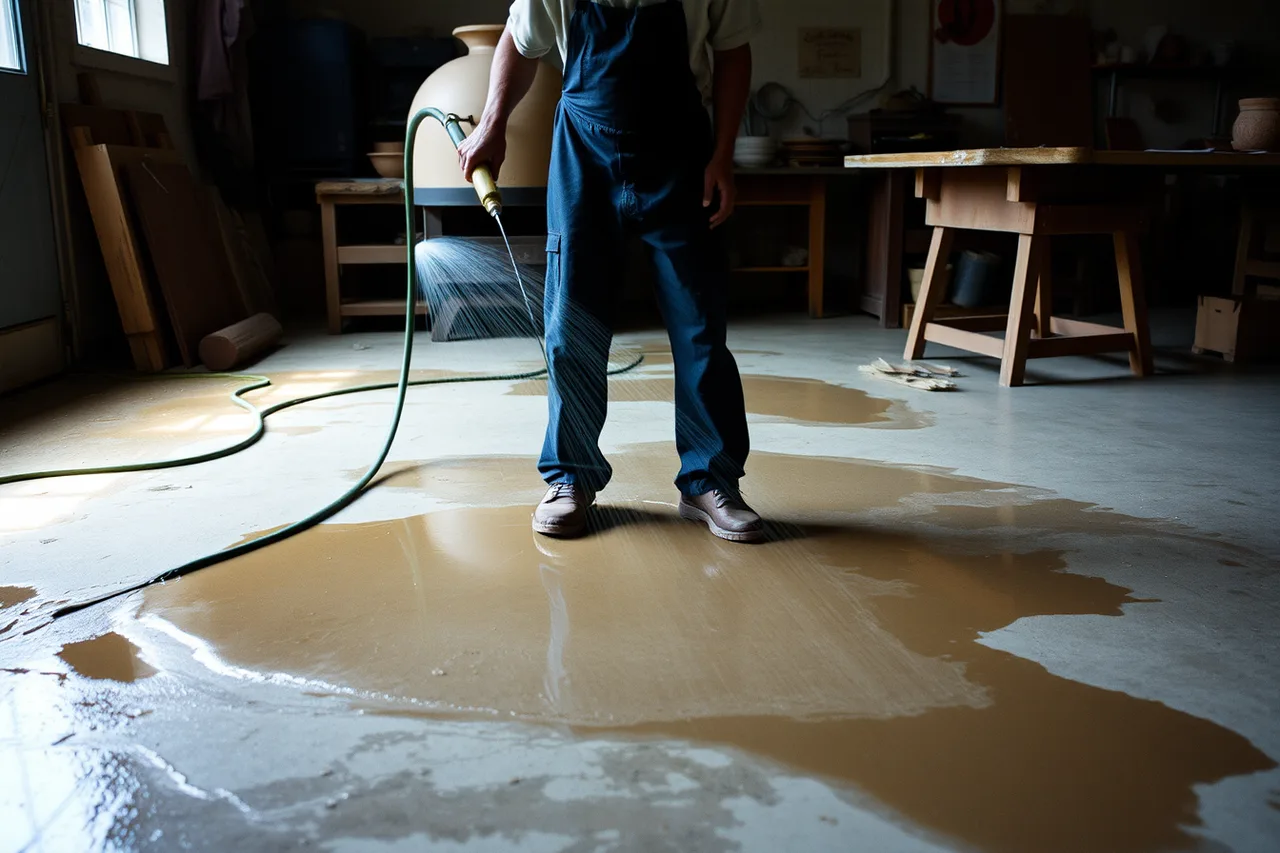
Its housekeeping entries are two lines: hose down the floor frequently and at the end of each shift, and clean up wet slurry before it dries and becomes airborne.
That second line is the whole principle. Wet clay is not a hazard. Dried clay that gets disturbed is. That means cleaning at the end of the session rather than at the start of the next one.
Glaze waste is the same problem in a bucket. Let it settle, pour off the clear water, and dispose of the solids the way your municipality requires. Never pour glaze down a sink.
Mistake three: firing work that is not ready
Firing work that is not ready
| Symptom | Cause | Prevention |
|---|---|---|
| Piece shatters in bisque | Water still in the clay | Wait until weight stops falling |
| Base blown out | Air pocket from poor wedging | Wedge properly; cut a test piece open |
| Pot welded to the shelf | Glaze on the foot | Dry foot everything; wash the shelf |
| Shelf ruined | Wrong clay body in a high firing | Run one body, label everything |
| Cracks after firing | Cooled too fast | Let the kiln cool on its own |
| Unloaded while hot | Kiln still hot inside | Wait until fully cool; cooling takes about as long as heating, and the kiln stays a hazard throughout |
Bone dry is not a feeling. A piece that has stopped losing weight between days is dry; one that still feels cool to the touch is not.
In a cold US winter, say Minnesota or upstate New York, a garage or unheated room slows drying to a crawl, and a thick-walled piece can sit damp for a week or more.
Mistake four: trusting the controller alone
Controllers drift, elements age, and thermocouples read only the spot they occupy.
A college ceramics glossary draws the distinction: a pyrometer measures heat at high temperatures. Pyrometric cones are compounded to bend and melt at specific temperatures, letting the potter tell when firing is complete. The instrument reports a number; the cone reports what happened to the clay.
The result of trusting only the instrument is a kiln that quietly underfires for months, producing pots that look fine and turn out porous. Cones in every firing catch that, and a log makes the drift visible over time.
If a firing starts taking noticeably longer to reach the same cone, the kiln is telling you the elements are near the end of their life. Plan for it as maintenance, not a fault.
All of this rests on getting the installation right first and on holding the material choices steady long enough for a pattern to appear.
Common questions
Can I fire without a vent if I open a window?
No. An open window dilutes; it does not capture. The fume passes through the room, and you, on its way out.
How dry is dry enough?
Weigh a piece on consecutive days. When the weight stops dropping it is bone dry. For thick work that can be a week or more.
Is it safe to be in the house while the kiln fires?
With a ducted vent, clearances met and nothing combustible nearby, yes, provided someone is around. An unattended kiln is a bad habit even with a controller.
What if my kiln overfires?
Stop using it until the controller and thermocouple are checked. Overfiring melts glaze onto shelves and elements and is expensive to repeat.
Can a kiln go in an unheated garage?
Only if the manual's ambient range allows it, which for many kilns starts near 40 degrees Fahrenheit. Cold rooms also slow firings and can confuse controllers.