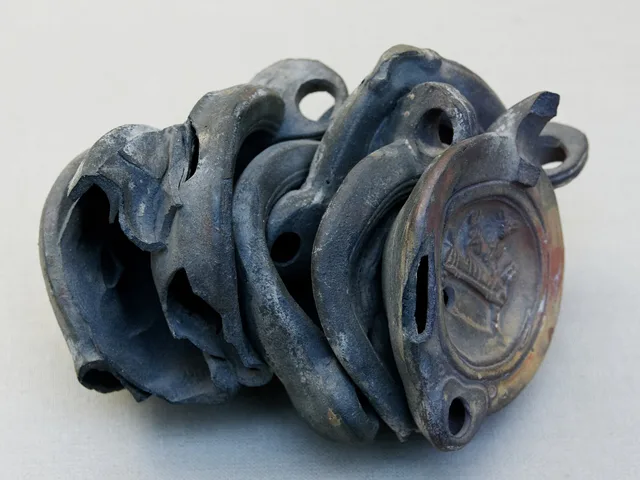
![These shards of broken pottery likely date to the Song Dynasty. They were prized for their rich blue and purple colors. The shards were collected and mounted to show off their coloration. This may have taken place at the end fo the 18th century during the Qianlong [Ch'ien-lung] emperor's reign. Why treat pottery losses as a line item in the supply budget?](/covers/how-to-price-supplies-for-pottery-studio-mistakes-1800.webp?v=18803534)
Costs
Part of Pottery studio failures: underfiring, crazing, and how handling breaks pots
Why treat pottery losses as a line item in the supply budget?
Losses are a supply cost. How to build a waste allowance into pottery costs, and what published exhibition and sale figures show about the rest.
Every pot that fails carries the full cost of the pots that succeeded: the clay, the glaze, the two firings and the hours. Most home budgets leave that out, which is why the numbers never match reality.
What to take away
- Put a loss rate in the budget. If one piece in eight fails, every survivor costs about 14 percent more.
- Selling costs are separate from making costs, and they are usually underestimated.
- Published exhibition budgets show how wide the range is, so plan yours rather than assume.
- Sale rules can cap your price, which changes what is worth making.
Losses are a line item
Track them for one batch and the arithmetic becomes obvious. Count what went into the kiln and what came out usable. Cracks, warps, glaze runs, crazing and pieces stuck to shelves all count.
Eight mugs go into the kiln with $200 of clay, glaze and firing behind them. One cracks while cooling. Divide the total batch cost by the survivors and you have a real cost per pot: $28.57 each, against $25.00 if all eight had lived.
US supply costs vary by region and supplier, so treat these as typical ranges. Stoneware clay retails at roughly $1 to $2 per pound in bulk bags, and more in small quantities. A pint of commercial glaze runs about $15 to $30 and covers several pots.
Dry glaze mixed from powder costs less per pot. Firing fees at shared kilns are usually charged by the pound, by the shelf or by the piece. Check your supplier and your kiln before you set a batch cost.
Pottery Losses and Their Costs
Loss
- Cracked in bisque
- Not bone dry
- Glaze run onto shelf
- Too thick, or glaze on foot
- Crazing
- Glaze and body mismatch
- Warped flat pieces
- Uneven drying
- Broken in handling
- Carried by handle or rim
Typical cause
- Cracked in bisque
- Clay plus one firing
- Glaze run onto shelf
- The pot, plus shelf repair
- Crazing
- The pot, and skipped glaze test
- Warped flat pieces
- Clay plus one or two firings
- Broken in handling
- Everything, at the last step
What it costs you
- Cracked in bisque
- Glaze run onto shelf
- Crazing
- Warped flat pieces
- Broken in handling
Selling costs are their own budget
Anything you show or sell carries costs beyond clay. A published guide from Carleton College to budgeting for an exhibition gives worked examples at both ends: a small display at $107.50 for photos, adhesive tabs and printing.
Exhibition Budget Examples
- $107.50Small display photos, adhesive tabs, printing
- $4,765.00Large exhibition posters, shipping, honoraria, frames, refreshments
- $10 to $40,000Recommended exhibition budget range
A large exhibition costs $4,765.00 for posters, shipping, honoraria, frames and refreshments, with travel for a guest lecturer. The guide says exhibitions cost anywhere from $10 to $40,000, so it recommends budgeting in advance.
Those are exhibition figures rather than craft fair figures, but the structure transfers. Printing, display and transport are real, arrive together, and stay invisible until you commit.
Where the wasted money actually sits
- Kiln space used by work that will not survive glazing.
- Glaze mixed in quantities that settle before you use them.
- Clay bought in bulk and allowed to stiffen.
- Time spent making pieces the venue will not accept.
When venue sale rules cap your price
Where you sell can also set limits. The published rules for North Carolina State University's student art sale require that artwork be priced at $600 or less unless the sale manager gives written approval.
Students get three entries on the virtual gallery page, and award-eligible work is capped at 44 inches tall by 50 wide by 12 deep.
The same arithmetic applies to the cap. A $600 ceiling does not bite on a $28.57 mug, but it does on a large platter that eats a whole shelf. Compare the capped price with the loss-adjusted cost per pot before you commit the kiln.
Fold the cap into the cost per pot and the buying order you set.
Common questions
What loss rate should I assume?
Measure it rather than assume it. Beginners often lose one piece in four; an experienced potter on a familiar body and glaze may lose one in twenty.
Do I charge for pieces that failed?
Not directly. You cover them by pricing the survivors to carry the whole batch cost, which is what a loss allowance does.
Are firing fees per piece or per load?
Both exist. Studios charge by the pound of clay, by the shelf or by the piece, and the structure changes what size work is economical for you.
Should I make cheaper work to sell more?
Only if the cheaper work costs proportionally less to fire, which it usually does not. Kiln space, not clay, is what small cheap pieces consume.