Reviews
Part of A planning checklist for turning a spare room into a pottery studio
Storing wet clay, dry chemicals and fired work in a home pottery studio
Wet clay, dry chemicals, and fired work each fail differently: double bag clay, label and date every powder, and pad fired ware on covered shelves.
Storage in a pottery studio is three separate problems that people try to solve with one shelf. Wet clay, dry chemicals and finished ware each fail in a different way, and each has a different answer.
What to take away
- Wet clay fails by drying out. Double bag it and keep it off concrete.
- Dry chemicals fail by losing their label, which turns a material into hazardous waste.
- Fired work fails by abrasion and by stacking. Pad it and do not tower it.
- Nothing porous should store glaze or clay unlabeled and undated.
Wet clay and reclaim
Clay wants a cool spot away from heat and off bare concrete, which wicks moisture out through the bottom of the bag. Once a bag is open, double bagging buys weeks.
Reclaim needs a lidded container within reach of the wheel, because a bucket you have to walk to stays empty while scraps dry on the floor. Dried scraps are the studio's main dust source, so this is dust control as much as storage.
Dry chemicals need a system, not a shelf
This is where casual storage turns dangerous. A college ceramics health and safety handbook sets out why. Dry clay contains crystalline silica. Additives such as talc and iron oxide bring hazardous dusts or toxic metals. Glazes, underglazes and mason stains often carry toxic metal pigments.
The handbook treats materials containing barium, cadmium, chromium or lead as regulated waste. It bans red lead outright. It points to the seals required under the Labeling of Hazardous Art Materials Act, where AP means low hazard and CL means hazardous ingredients needing precautions.
The home version of that system is four rules:
- Every container gets a label with the material name and the date it was opened or mixed.
- Keep the supplier's safety data sheet for anything you own in powder form.
- Flammables live in their own closed cabinet, not on an open shelf.
- Nothing unlabeled gets used. It gets disposed of properly instead.
An unlabeled bucket of gray powder is not a mystery to solve. It is a disposal problem you created six months ago.
Finished and fired work
Conservation practice for ceramic and glass objects starts by reducing handling, since every move risks knocking off a weak glaze or dropping a piece. It notes that dust is abrasive and scratches glazed ceramics, degrading even hard, non-porous surfaces if left in place.
At home, use dust-covered shelving, never stack without padding between pieces, and keep fragments of anything broken together in one padded tray.
Fit shelving into the plan early, since it competes for the same wall as everything else in a studio layout. Machines bought later want floor area you may already have given to tools and their storage.
Where each thing should live
| Material | Container | Conditions |
|---|---|---|
| Bagged clay | Double bag inside a lidded bin | Cool, off bare concrete |
| Reclaim | Lidded bucket at the wheel | Kept wet, never allowed to dry |
| Dry powders | Sealed, labeled, dated tubs | Dry, closed cabinet, off the floor |
| Mixed glaze | Lidded bucket, recipe on the lid | Stirred before use, dated |
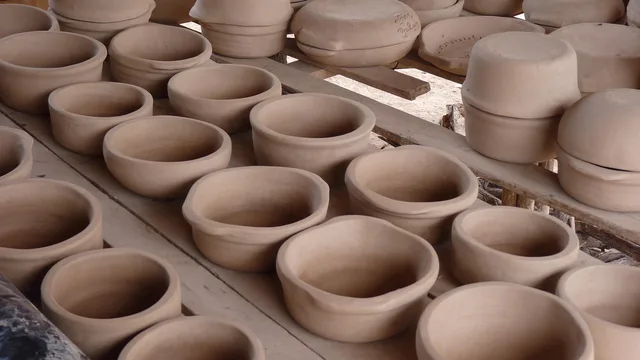
| Greenware | Open shelf, no drafts | Bone dry before firing |
| Fired ware | Padded shelf with a dust cover | No stacking without padding |
Common questions
How long does bagged clay keep?
Indefinitely if sealed and unfrozen. Stiffened clay can be reclaimed; clay frozen and thawed repeatedly often will not throw well again.
Can I store glaze in old food containers?
Only if the original label is removed and a new one applied. A glaze bucket that still says yogurt is how something gets eaten or poured out wrongly.
Do dry glaze materials go bad?
Sealed and dry, most keep for years. What degrades is your knowledge of what is in the tub, which is why dating a label matters as much as naming it.
Where should greenware wait for firing?
On open shelves out of drafts and never in a sealed box. It has to reach bone dry before it goes near a kiln.