Reviews
Best Air Purifier for Pottery Dust in a Home Studio
We name five true HEPA purifiers that fit home pottery studios: Coway Airmega 400, Winix 5500-2, Honeywell HPA300, Levoit Core 600S, Medify MA-40.
What to take away
- Buy a true HEPA purifier sized to your room before you buy a second wheel or a bigger kiln.
- Match the unit's clean air delivery rate to the room, not the price tag.
- Skip ozone generators, ionizers, and purifiers sold only for odor control. Silica is the problem, not smell.
- Add an inexpensive particle counter so you can see whether the unit is working.
- Upgrade when the counter shows dust lingering after a throwing session, or when the room grows.
Sizing a purifier to a home studio
The key number is clean air delivery rate, or CADR, in cubic feet per minute. The EPA's summary of residential air cleaners notes that CADR is measured separately for dust, pollen and smoke. Check the dust figure, not the headline number.
Room Size vs Dust CADR
Up to 120 sq ft
- Target dust CADR
- 70 to 90 cfm
- Filter cost per year
- $40 to $80
120 to 200 sq ft
- Target dust CADR
- 90 to 140 cfm
- Filter cost per year
- $60 to $120
200 to 350 sq ft
- Target dust CADR
- 140 to 230 cfm
- Filter cost per year
- $90 to $180
A rough rule is to pick a unit whose dust CADR is at least two thirds of the room's floor area in square feet. A 150 square foot spare room points to a dust CADR near 100 cfm.
That rule is illustrative, not a standard. It assumes an eight foot ceiling and a sealed room. If you throw with the door open to the rest of the house, size up.
HEPA is the filter claim to look for. A true HEPA filter captures 99.97 percent of particles at 0.3 microns. Respirable crystalline silica sits largely in that range. Units sold as HEPA-type or HEPA-like are not the same thing.
Sizing a purifier
| Room size | Target dust CADR | Typical filter cost per year |
|---|---|---|
| Up to 120 sq ft | 70 to 90 cfm | $40 to $80 |
| 120 to 200 sq ft | 90 to 140 cfm | $60 to $120 |
| 200 to 350 sq ft | 140 to 230 cfm | $90 to $180 |
Those dollar ranges are for planning only. Filter price depends on the brand and how often you replace it.
Five named air purifiers for a home studio
These models are widely available in North America and have true HEPA filters.
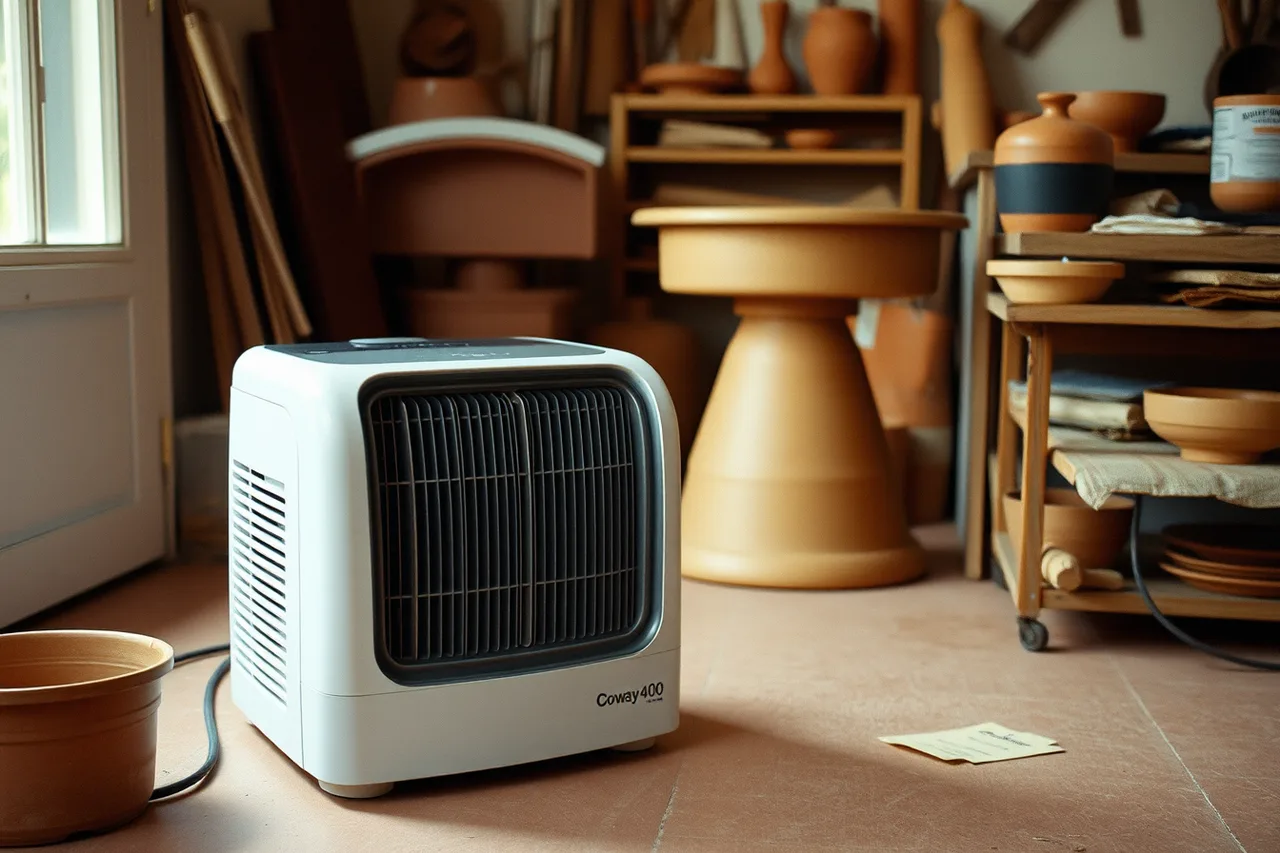
- Coway Airmega 400: covers up to 1,560 square feet and has a washable prefilter. It suits a converted garage or a large spare room. Replacement filter pairs run about $90.
- Winix 5500-2rated for 360 square feet with a dust CADR near 243 cfm. Its PlasmaWave ionizer can be turned off. Price is often under $170.
- Honeywell HPA300true HEPA with dust CADR of 300 cfm and coverage for 465 square feet. It is easy to find filters at big box stores.
- Levoit Core 600Sdust CADR of 410 cfm and coverage up to 635 square feet. It has smart controls and a quiet sleep mode. Price is around $300.
- Medify Air MA-40uses a true HEPA H13 filter and covers 840 square feet. It is an affordable option with a dust CADR near 330 cfm.
What can wait
A second purifier for the kiln corner can wait because kiln fumes need ventilation, not filtration. The EPA notes that firing gives off volatile organic compounds that a room purifier will not address.
Read how to pick a clay body, glaze and cone that make a kiln fire properly before you spend on air handling. Clay choice changes dust production.
A whole-room negative air machine can wait too. Those belong to contractors cutting tile, not to a potter trimming six mugs.
What to buy used
Purifiers are a poor used-market buy. Filters are the expensive part. A used unit usually arrives with a loaded filter and an unknown fan life. If you do buy used, price in a new filter immediately and check the manufacturer still stocks it.
A used particle counter is a better bet. Laser counters drift, but a calibrated unit from a lab surplus sale still tells you whether dust is rising. Pair it with the habits in which studio mistakes does a well-planned small space prevent so you capture dust at the wheel.
What never pays back
An ozone generator never pays back. Ozone is a respiratory irritant, and the EPA warns against units that intentionally produce it. You would add a hazard to a room that already has one.
An ionizer without a HEPA stage is close behind. It charges particles so they settle on surfaces, which means you vacuum more and breathe more during vacuuming.
A purifier bought to control kiln odor is the third. Vent the kiln to the outside instead. The EPA's page on volatile organic compounds and indoor air quality explains why source control beats filtration for gases.
How to tell when to upgrade
Set a threshold before you shop again. Run the particle counter for one hour while throwing and trimming, then compare the reading to the same hour with no work happening.
Test Your Purifier's Performance
- Record baseline with room empty
- Throw for 30 minutes with purifier on high
- Note peak reading and fall time
- Repeat on a second day
If the peak stays more than three times the baseline for over 20 minutes after you stop, the unit is undersized. Move up a size class.
If the peak clears within a few minutes, keep it. Spend the money on a fitted respirator instead. NIOSH publishes respirator guidance covering fit testing, which matters more than the purifier when mixing dry clay.
Buy the purifier first, the counter second, and the second unit only when the numbers say so. The order in some purchases prevent pottery studio mistakes better than others in 2027 applies here as much as anywhere.