Rules
CSA kiln approval in Canada: marks, nameplates, permits
Confirm a home kiln's Canadian electrical approval by matching the nameplate mark and model to a certification directory, then filing the provincial or territorial permit and inspection route. The guide names the authorities, forms and published fees that apply.
What to take away
- Check the nameplate for a mark recognized under Canada's electrical and fire codes: CSA, cUL, cULus, ULC or ETL/cETL.
- Match the exact model code and voltage to the certification body's public directory before you buy.
- No brand is approved as a brand; approval follows the model, voltage and controller.
- The provincial or territorial authority permits and inspects the circuit, not the retailer.
- Ontario files an ESA Notification of Work. Saskatchewan uses the Home/Farm Owner Electrical Wiring Permit. Alberta uses accredited agencies such as IJD Inspections Ltd.
- Nova Scotia Power's wiring permit form lists $69 for installations up to $2,000 and $138 for $2,001 to $4,000. Saskatchewan charges $30 for contractor work up to $1,000 and $155 an hour for inspections.
- A CE sticker is not a Canadian certification mark, and an inspector will treat that kiln as uncertified.
Who has jurisdiction over a home kiln
Two separate decisions decide whether a home kiln may run. First, an accredited certification body must list the appliance. Second, the provincial or territorial electrical authority must permit and inspect the circuit. The retailer does neither, and a sales invoice is not approval.
Kiln approval: two gates
- Step 1: Accredited testing organization certifies kiln
- Issues mark: CSA, cUL, cULus or ULC
- Step 2: Province adopts Canadian Electrical Code
- Province appoints authority to enforce it
- Authority issues permit and inspects circuit
- Approval is provincial: Ontario permit invalid in Alberta
Certification comes first. CSA Group, UL Solutions and Intertek issue marks after testing to a recognized standard, and each keeps a public directory. A mark printed on a carton is not proof; the directory entry for the exact model is. Ask the seller for the model and serial number before you compare.
Inspection comes second. Each province and territory adopts CSA C22.1, the Canadian Electrical Code, with local amendments and an appointed authority. Ontario uses the Electrical Safety Authority; British Columbia uses Technical Safety BC. Quebec's Régie du bâtiment du Québec licenses contractors, and the permit route depends on the work.
Verify the mark before you buy
Check the mark in the public directories. CSA Group's certified product search, UL Product iQ and Intertek's directory of listed products let you search a manufacturer, model or file number. A listing record names the standard and the product category, so confirm both cover an electric heating appliance before you trust the mark.
The standard most often cited for electric kilns is UL 499, Electric Heating Appliances; CSA Group's harmonized version is CSA C22.2 No. 499. Read the listing record instead of guessing from the shape of the mark, and note that ULC marks cover many categories. A sister model in the same family does not cover the unit in the crate.
Which kiln brands should you check?
Canadian studios commonly shop Skutt, L&L Kiln, Paragon, Olympic, Evenheat and Cone Art, but that is a research shortlist, not a certification list. Certification attaches to a model code, a voltage and often a controller, so a 120-volt test kiln that appears in a directory does not approve the 240-volt cabinet. Search the exact code, then ask the supplier for the listing record; this guide to clay and kiln suppliers shipping to Canada is a place to start.
What a compliant nameplate carries
Every legal kiln states its identity on a metal plate. Photograph that plate before the kiln is pushed into a corner, because an inspector will ask to see it. The photo also ties the permit and the insurance record to the appliance.
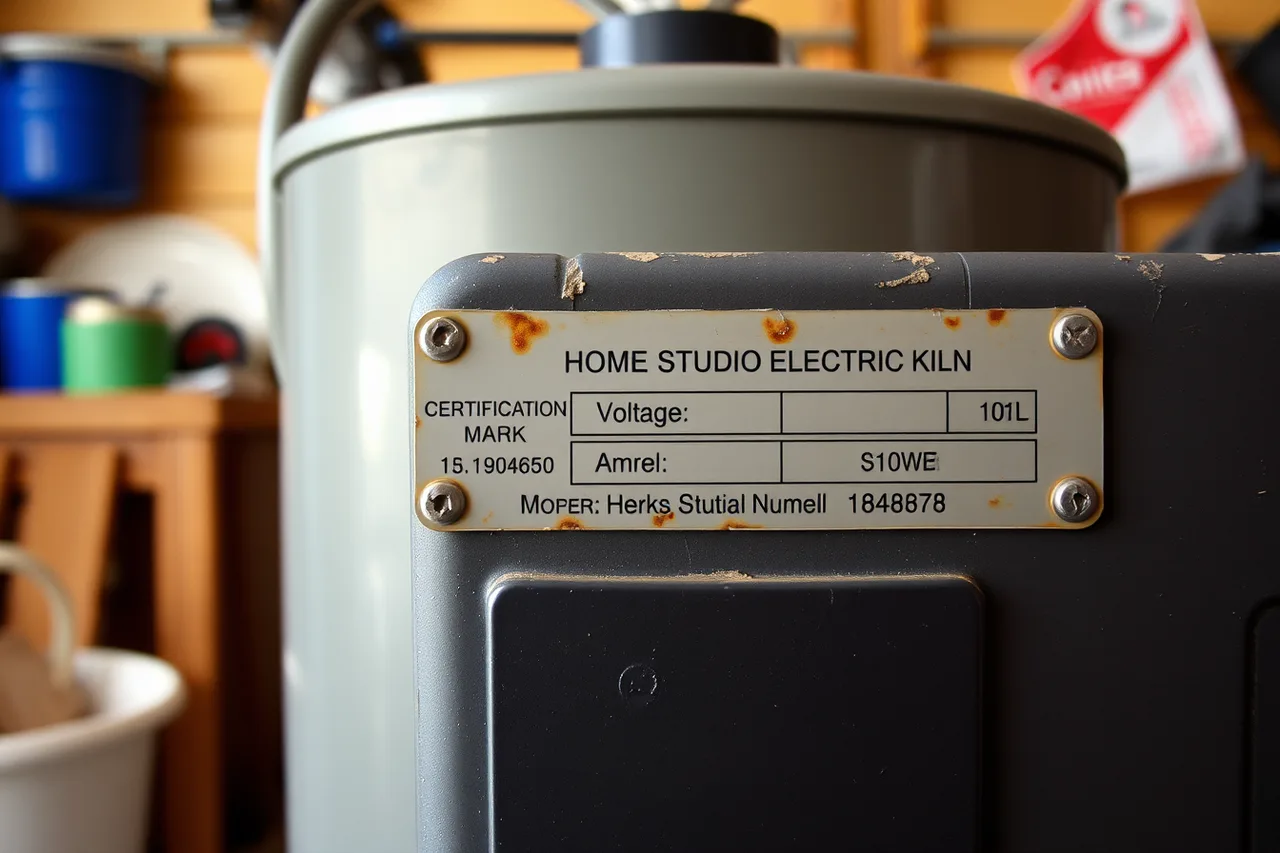
| Nameplate field | What it shows | Why it matters |
|---|---|---|
| Certification mark | CSA, cUL, cULus, ULC, ETL or cETL | Shows the kiln was tested to a recognized standard |
| Voltage and amperage | The supply the kiln needs | Sets breaker and conductor size |
| Wattage or kilowatt rating | Total connected load | Confirms the circuit cannot be shared |
| Model and serial number | The identity of one unit | Ties the permit and the insurance record to your kiln |
| Manufacturer or importer | A party answerable in Canada | Gives an address for recalls and spare parts |
Voltage, amperage and wattage set the breaker and conductor size; the model and serial number identify one unit. The manufacturer or importer must be answerable in Canada. A missing mark or a rating that does not match the breaker is grounds for an inspection order that paperwork cannot fix later.
How an unlisted kiln gets a CSA mark or file number
A CSA mark is issued to a manufacturer, not to a kiln owner. The manufacturer submits a representative unit to CSA Group, UL Solutions or Intertek, which tests it to CSA C22.2 No. 499 or UL 499. If it passes, the body issues a listing record with a file number and the manufacturer applies the mark.
A field evaluation is not a CSA listing. It examines one installed unit against Canadian requirements and produces a field evaluation label, not a file number that covers every sister model. A homeowner who buys an unlisted kiln cannot turn it into a listed model; only the manufacturer can do that.
An existing kiln with a missing mark may still be acceptable through field evaluation, but ask the inspecting authority in writing before you pay. Ask what standard and label the evaluation body will use, and keep that label with the permit and insurance file.
Permits: what each province and territory files
Ontario uses the Electrical Safety Authority. A Licensed Electrical Contractor files ESA's Notification of Work before work starts; ESA treats that notification as the permit and schedules inspection. Ask for ESA's Certificate of Acceptance and keep it with your insurance record.
British Columbia uses Technical Safety BC. The contractor files an Electrical Permit application before work begins. Technical Safety BC publishes an electrical fee schedule, and the fee follows the declared value of the installation. A building permit never replaces the electrical permit.
Alberta enforces the Safety Codes Act through Alberta Municipal Affairs, the Safety Codes Council and accredited agencies that issue electrical permits. Named agencies include IJD Inspections Ltd., Park Enterprises Ltd. and Superior Safety Codes Inc. Municipal Affairs Safety Services answers route questions at 1-866-421-6929.
Saskatchewan uses the Technical Safety Authority of Saskatchewan, known as TSASK. Its Home/Farm Owner Electrical Wiring Permit covers single-phase, non-hazardous work up to 200 amps or 300 volts, runs for 12 months and requires rough-in and final inspections. Anything larger needs a licensed Saskatchewan electrical contractor.
Manitoba Hydro administers electrical inspection in Manitoba. The contractor files an Electrical Permit Application with Manitoba Hydro before work starts, then requests rough-in and final inspections. Manitoba Hydro issues the permit and inspection record; keep both for the insurer.
Quebec licenses electrical contractors through the Régie du bâtiment du Québec. The permit route depends on the work and the municipality: the contractor should confirm whether the local building department or the RBQ process applies. Ask for the exact form and inspection sequence before work starts. Keep the result with your basement studio permit and insurance records.
Atlantic provinces
Newfoundland and Labrador issues electrical permits through Service NL's Electrical Inspection Section. The contractor files an Electrical Permit Application before work starts and calls for rough-in and final inspection. Confirm the current form and fee with Service NL, because the province sets its own schedule.
Nova Scotia uses Nova Scotia Power's Wiring Permit Contact Centre. A certified electrician files the Application for Wiring Permit and Inspection and requests inspection through the same office. The form includes a fee table, a minimum residential charge and hourly inspection rates. Confirm the current schedule before you budget.
New Brunswick uses NB Power's Electrical Wiring Permit Application Form, submitted online or by phone. The permit number is required when the contractor calls Technical Inspection Services at the Department of Public Safety for the final inspection. Service New Brunswick offices also accept technical inspection applications.
Prince Edward Island's Electrical Inspection Section administers permits under the Electrical Inspection Act. The contractor applies to an inspector before work starts, and the supply authority cannot connect until a permit is secured. Confirm the current form and fee with the inspector, because the route is local.
Territories
Yukon's Electrical Inspection office issues electrical permits. The contractor files an electrical permit application before work starts and requests inspection at rough-in and completion. Confirm the current form and fee with the office, because Yukon sets its own schedule.
The Northwest Territories Office of the Fire Marshal administers electrical inspection. The contractor files an electrical permit application before work starts, and the office inspects the installation. Confirm the route with Municipal and Community Affairs, which publishes the territory's fee information.
Nunavut's Department of Community and Government Services handles electrical inspection. The contractor applies for an electrical permit before work starts and requests inspection. Confirm the current form and fee with the department, because Nunavut does not follow a provincial schedule.
Approval is local. A permit issued in Ontario means nothing in Alberta, and a kiln moved to a new province needs the new authority's route. Buyers who miss this usually learn through a refused permit, one of the home kiln setup mistakes that surfaces once an inspector is already involved.
What permits cost
Saskatchewan publishes figures. TSASK's 2024–2025 Electrical Fee Schedule prices contractor installation permits by declared job cost: $30 for work up to $1,000, $45 for $1,001 to $2,500, $75 for $2,501 to $5,000, $125 for $5,001 to $10,000 and $175 for $10,001 to $25,000.
Inspections and professional services, field evaluations included, cost $155 an hour. Special inspections outside regular hours cost $232.50, and statutory holiday inspections cost $310. TSASK introduced a new fee structure on August 7, 2024 and publishes a permit fee calculator, so confirm the current amount before you apply.
Nova Scotia Power's Application for Wiring Permit and Inspection lists $69 for installations valued up to $2,000, $138 for $2,001 to $4,000 and $233 for $4,001 to $6,000. Fees follow installed value, so circuit size matters. Confirm the current schedule before you pay.
Other provinces publish fees through the authority or utility, not one comparable table. Alberta agencies set their own schedules, so ask the agency covering your municipality for a written quote. Travel charges may also apply to rural inspections, so ask first.
What a home studio may and may not do
In cold provinces, unheated garages add condensation and frost to the electrical questions, as this guide to garage kilns through a British Columbia winter explains. A listed kiln on a dedicated circuit that matches its nameplate remains the normal legal arrangement, shared with nothing else.
Hire a licensed electrician, keep the manufacturer's clearances to combustibles, and never borrow a dryer or range circuit. A larger breaker does not fix a missing certification mark. In most provinces a new circuit needs a permit and inspection, the electrician applies, and the inspector checks the work before it is concealed.
Ask about field evaluation for an imported kiln
An imported kiln may arrive with only a US listing. Ask the authority whether it accepts a field evaluation before you pay for one. In that route an accredited body such as CSA Group, UL Solutions or Intertek examines the installed appliance against Canadian requirements, and the authority decides whether to accept the result.
Outside Saskatchewan, acceptance is decided by the authority that inspects the circuit. Ask Ontario's Electrical Safety Authority, Technical Safety BC or the Alberta accredited agency whether it will accept a field evaluation before you pay. Get that answer in writing, with the exact model and voltage named.
Cost is charged by time. TSASK lists field evaluations under its $155 hourly inspection rate, so a two-hour visit starts near $310 before travel. Other authorities in this guide do not publish one field-evaluation fee; CSA Group, UL Solutions and Intertek quote by time and travel. Get the quote and the authority's decision before booking.
Records to keep after the inspector leaves
- The electrical permit number and the inspection certificate
- A clear photograph of the nameplate, certification mark included
- The invoice from the licensed electrician who did the work
- The manufacturer's installation manual and clearance diagram
- Your insurance endorsement or rider naming the kiln
Keep the permit and inspection certificate where you can find them quickly, because an insurer may ask for both after a fire, sometimes years later. Add firing records to the same folder: cone, temperature, load and any fault. That log shows what the kiln has actually done.
What happens if you skip certification or inspection
The consequence is not a warning letter. An inspector who finds an unlisted kiln or a circuit that was never inspected can order it disconnected, and the utility can cut power until the work is corrected. A fire traced to an uncertified appliance gives an insurer grounds to deny the claim. On resale, an uninspected circuit can hold up a closing.
If you are buying in the United States
US readers face a parallel system. Under the National Electrical Code a kiln needs a listing from a nationally recognized testing laboratory, shown by a UL or ETL mark, and the local authority having jurisdiction issues the electrical permit. UL Product iQ lists models, and the rule is the same: match the exact code. The lessons makers report after a failed inspection travel well.