Reviews
Part of Home pottery budget: a per-firing method and two benchmarks
Home Pottery Buying Order: What to Buy First
A cheapest-first guide to home pottery buying: clay and tools first, a used wheel later, a kiln last — plus how to work out a kiln's running costs.
A tight budget changes the buying order, but not as much as people expect. The first purchases are cheap anyway. What changes is how long you wait before the expensive ones, and whether you can work out the running cost before you commit.
What to take away
- The first hundred dollars buys clay, a surface and four tools. That is a real practice.
- Work out what a kiln costs to run before you buy one, not after.
- Ventilation is the one safety purchase to make early, because it is a building change.
- Rent firing until the arithmetic says owning is cheaper.
The order, cheapest first
- A bag of premixed clay and a bucket.
- A wire, a needle tool, a rubber rib and a sponge.
- A sealed board to work on and a plaster slab you cast yourself.
- A mop, a bucket and gloves. Cheap, and not deferrable.
- Firing, bought from a studio or a supplier by the piece or the pound.
- A wheel, used, once you know you want one.
- A kiln, last, and only after the running cost is known.
Steps one to five are a complete practice. Many people stay there for a year and produce good work.
Buying order, cheapest first
- Premixed clay and a bucket
- Wire, needle tool, rib, sponge
- Sealed board and plaster slab
- Mop, bucket and gloves
- Firing by piece or pound
- Used wheel once committed
- Kiln last, after running cost
Work out the running cost before you buy the kiln
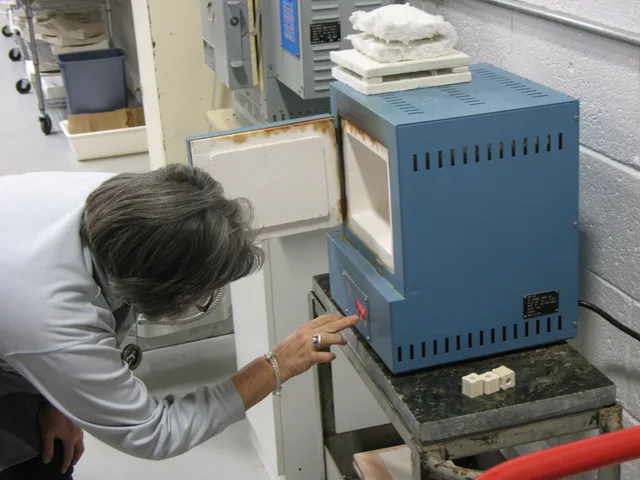
The arithmetic is simple and nobody does it first. A kiln's power draw is on its data plate in watts. Energy in kilowatt-hours is power in kilowatts multiplied by hours, and watts convert to kilowatts by dividing by 1,000. Multiply the result by your utility's rate per kilowatt-hour and you have the cost of a firing.
Two corrections make the estimate honest. Elements cycle on and off rather than drawing full power throughout, so the true figure is lower than the flat calculation, and a metered firing beats any estimate. And a bisque and a glaze firing are two separate costs for the same batch of pots.
Work out the running cost
| Input | Where it comes from |
|---|---|
| Kiln wattage | The data plate on the kiln |
| Firing hours | The manufacturer's schedule, then your own log |
| Rate per kilowatt-hour | Your utility bill |
| Firings per month | Your realistic making rate, not your hoped-for one |
The purchase not to defer
Ventilation. It is the only item on the list that changes the building. Retrofitting later costs more than doing it at the start.
OSHA's ventilation standards and the ACGIH Industrial Ventilation manual treat ventilation as an engineering control against harmful air contaminants and heat. Both distinguish dilution ventilation from local exhaust and fume hoods. The choice should follow from hazard analysis and good engineering practice, with periodic inspection and maintenance records.
Read that as a budget instruction. A kiln vent is not a one-time purchase; it is a system that needs checking and keeping records for. If a kiln is anywhere in your plan, price the vent alongside it in the total cost rather than treating it as an accessory.
What to buy used and what not to
Wheels, wareboards, banding wheels and tables are good used buys; they are simple and last. Kilns are riskier because elements, bricks and controllers age, and an old controller may lack spare parts.
Buy a used kiln only if you can see it fire, or if the price already assumes new elements. Build the rest of the setup around the surfaces you can make yourself.
Common questions
Can I start with air-dry clay to save money?
You can make things, but it is a different material with different behavior, and nothing you learn about drying or glaze fit transfers. Fired clay is the craft.
Is a test kiln a sensible first kiln?
Often, yes. It plugs into a normal outlet, fires glaze tests and small work, and answers the question of whether you will actually fire regularly.
How do I find firing services?
Ask local clay suppliers, community studios and college continuing education programs. Many fire other people's work when the kiln has room.
Should I buy the good wheel now to avoid upgrading?
Only if you already know you will throw regularly. Otherwise the used wheel that gets resold at no loss is the cheaper way to find out.