Reviews
Part of Independent ceramic studios companies: a way to assess work
Independent ceramic studios reviews: questions to ask
Independent ceramic studios reviews: ask about firing, clay, glaze records and vitrification, then check care details before buying handmade pottery.
What to take away
- Five studios are namedHeath Ceramics, Bauer Pottery, Jono Pandolfi, Haand and Duck Creek Ceramics. Detail varies, so confirm missing price, firing and care information with the maker.
- Ask four questions before payingfiring cone, clay body, glaze test records, and vitrification.
- For functional ware, ask the maker about glaze testing and intended care; appearance alone cannot confirm those details.
- Terms such as slip trailing and Rozane Royal help describe surface decoration, not rank a studio.
- No pots were bought or tested for this article. Prices are published figures or labelled ranges.
What home studios can take from this comparison
Readers looking for independent ceramic studios reviews can use this article's observations as benchmarks for their own work, not only as shopping advice. Clay Home Lab is for home potters and small ceramics studios.
The five studios show how form, surface, firing and price connect. A home studio can use the same grid to judge its own cups and plates. The four questions below are also the questions to ask before firing a load or selling a pot.
If you work in a small studio, the table's firing and care notes point to what you should test and record. A buyer's question about cone or glaze records is your chance to show that your home studio practice is deliberate.
Use the five studios as case studies for your own making decisions, not only as a shopping list. The same standards a curator applies to their work can guide the cups and bowls you make at home.
What to notice across five independent studios
The five studios show different approaches to form, surface and firing. Two are production houses, one supplies restaurants, and two work in small batches. The guide to how independent studios and residencies operate covers the smaller operations that never reach retail.
The five studios, compared
Form
- Heath Ceramics, Sausalito, California
- Coupe and Rim profiles, built to stack and serve
- Bauer Pottery, Los Angeles
- Ring-handle pitchers, wheel-thrown and slip-cast in small runs
- Jono Pandolfi, Union City, New Jersey
- Plate profile and stacking built for restaurant service
- Haand, Burlington, North Carolina
- Thin walls, light cups and bowls
- Duck Creek Ceramics, Cincinnati, Ohio
- Small-batch studio ware, sold direct
Surface
- Heath Ceramics, Sausalito, California
- Matte, earthy glazes on heavy stoneware
- Bauer Pottery, Los Angeles
- Saturated color, historic shapes
- Jono Pandolfi, Union City, New Jersey
- Restaurant-standard glazes
- Haand, Burlington, North Carolina
- Muted glazes
- Duck Creek Ceramics, Cincinnati, Ohio
- Studio glaze, method not published
Firing and care
- Heath Ceramics, Sausalito, California
- High-fired stoneware, dishwasher safe
- Bauer Pottery, Los Angeles
- Production scale, cone not published
- Jono Pandolfi, Union City, New Jersey
- Built for commercial dishwashers
- Haand, Burlington, North Carolina
- Hand-wash recommended
- Duck Creek Ceramics, Cincinnati, Ohio
- Ask for cone, clay body and test records
Typical direct price
- Heath Ceramics, Sausalito, California
- $40 to $60 a plate, about $40 a mug
- Bauer Pottery, Los Angeles
- $25 to $45 a plate, $100 to $200 a pitcher
- Jono Pandolfi, Union City, New Jersey
- $45 to $75 a plate, about $180 a four-piece setting
- Haand, Burlington, North Carolina
- $45 to $65 a cup, $50 to $75 a plate
- Duck Creek Ceramics, Cincinnati, Ohio
- Typical small-studio range, about $35 to $60 a cup and $30 to $55 a plate
Best for
- Heath Ceramics, Sausalito, California
- A full set that survives a dishwasher
- Bauer Pottery, Los Angeles
- Furnishing a table rather than collecting one piece
- Jono Pandolfi, Union City, New Jersey
- Restaurant-grade function without restaurant quantities
- Haand, Burlington, North Carolina
- Light cups, for a buyer who will hand-wash
- Duck Creek Ceramics, Cincinnati, Ohio
- A local maker, for a buyer who will do the checking
Read this grid as a snapshot of available information, not a lab result. No pot was bought, handled or tested for this article. The listed published figures or labelled typical ranges are as of 2026; where a studio does not publish a direct price or firing detail, confirm it with the maker.
Four questions to ask before you pay
- What cone was this fired to, and was the kiln electric or reduction?
- What clay body is it, and is that body vitrified at that cone?
- What glaze tests, if any, were done, and what do their records cover?
- Does the maker expect a dishwasher, or a hand wash?
A record from another firing proves little, because a result belongs to a body, a glaze and a kiln together. Glaze composition can help explain how a surface behaves, but it does not by itself establish how finished functional ware performs.
A schedule that leaves the body short of vitrification lets liquid reach the clay, so the clay body, glaze and cone combination has to be judged as one decision.
Ceramic surface terms to recognize
Named techniques give you words to ask questions with. The Ohio art pottery record at Kent State holds more than 130 pieces from Roseville, Weller, Rookwood and McCoy, made in the Zanesville and Cincinnati corridor between the 1860s and the 1960s.
Rozane Royal used a thin slip blended into a brown background under a clear glaze. Slip trailing pushed clay threads from a squeeze bag to outline decoration. A third line cut away the background to reveal decoration under an overglaze.
Applied to the five: Bauer Pottery's saturated shapes sit closest to the Roseville line, so ask whether the color is sprayed glaze or slip under clear. Heath's matte palette is glaze chemistry on heavy stoneware.
Haand runs similar chemistry on thin porcelain. Jono Pandolfi picks glazes for commercial washing. Duck Creek publishes no surface method, so ask which of these it uses.
What to look for on a cup
What a curator marks
- Formdoes the profile carry through, or stall at the shoulder?
- Foottrimmed and finished, or an afterthought?
- Surfacehow was it made, and does it sit with the form?
- Weightright for the size, especially in a cup?
- Functiondoes the handle fit, does the spout pour, does the lid seat?
- Firingwhat cone, what atmosphere, is it vitrified?
Six questions for judging a pot
- Formdoes the profile carry through?
- Foottrimmed and finished, or afterthought?
- Surfacehow was it made, does it sit?
- Weightright for size, especially a cup?
- Functionhandle, spout, lid seat?
- Firingwhat cone, atmosphere, vitrified?
The last line is the one no photograph settles. Underfiring and crazing are the visible signs to hunt for, and pottery studio failures sets out how each one starts and what it costs a maker.
What a juried selection actually measures
Selection, not measurement. One university gallery's biennial ceramics national took 153 works from 75 artists across 32 states, with a companion show given to handmade cups.
That figure tells you what two jurors chose from one season's entries. It is a signal about competition, in one gallery, in one year. It says nothing about cone, glaze safety or whether a pot suits your table.
How to tell handmade from mold-made
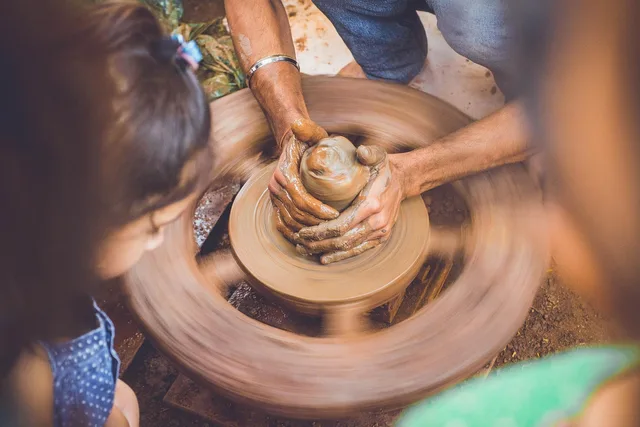
Look at the foot, the rim and the interior. Throwing rings, trimming marks and slight asymmetry are the evidence of a thrown pot. Perfect uniformity usually means a mold.
Slip-cast ware can be sold honestly as slip-cast, so ask which process made the piece. A molded rim runs dead straight, while a thrown rim often carries a slight wave. Trimming is the clearest tell of all, and the bat and wheel choices behind it are compared in first wheels and their bat systems.